
Men Like Animals
an homage to Hexenkartothek (Roxy)

Recently, my mutual ᛦ Roxy ᛦ took some injury during a kerfuffle with the Russians over on the ancestral steppe-land of our forefathers. He is fighting in Ukraine, and warfare has significantly changed from that very ancient time period where Stone Age chieftains battled against copper and bronze wielding warlords riding chariots. No longer are we beating each other with stone, deep strikes of flint arrow heads striking our bones, cracking skulls with electrifying blows from copper axes, or slicing muscle and bone with bronze blades. Now it’s the pitched whine of a drone, the clacking of bolts, the immolation and gassing of our bodies, the dazed confusion of explosions, and the shredding of muscle and bone under great pressure. However, there is some sort of kinship between the wolf-headed and bear-pelted warriors of the ancient past and the youthful mercenaries of the modern age, and I am going to take this opportunity to muse on the berserker cult and the warp-spasm they experience. A more complete article on the Gaelic warp-spasm (known as riastradh) will eventually be released on my other publication, Seòl nan Sinnsearan.
Steven McNallen, the Founder of the Asatru Folk Assembly and the Herald of Odin, was also a soldier. In his many writings, he often speaks of how Odin can possess a man with the chaotic substance to increase his agency and influence, to create a more perfect warrior, and to lead us towards eventual victory. Steven, like many other warriors of the modern age, is directly inspired by the ancient pagan past of our uncivilized but highly cultured and moralistic ancestors. Herald and Founder Steven McNallen is a personal hero of mine, and I cannot overstate his influence on the modern pagan restoration — his legacy is one of hard work, frenzied passion, and vitality. His organization is the only Whites-only church in existence which has multiple temples to multiple Gods, and I am personally oathed to this assembly. I recently slept in Freyrshof before the mural and idol of Freyr, and the Lord Freyr blessed me with dreams and passion of a sort that I have only briefly experienced in passing. As I lay before the golden mural and wooden idol, I realized that I am incredibly fortunate and blessed, having experienced something that few men can boast.
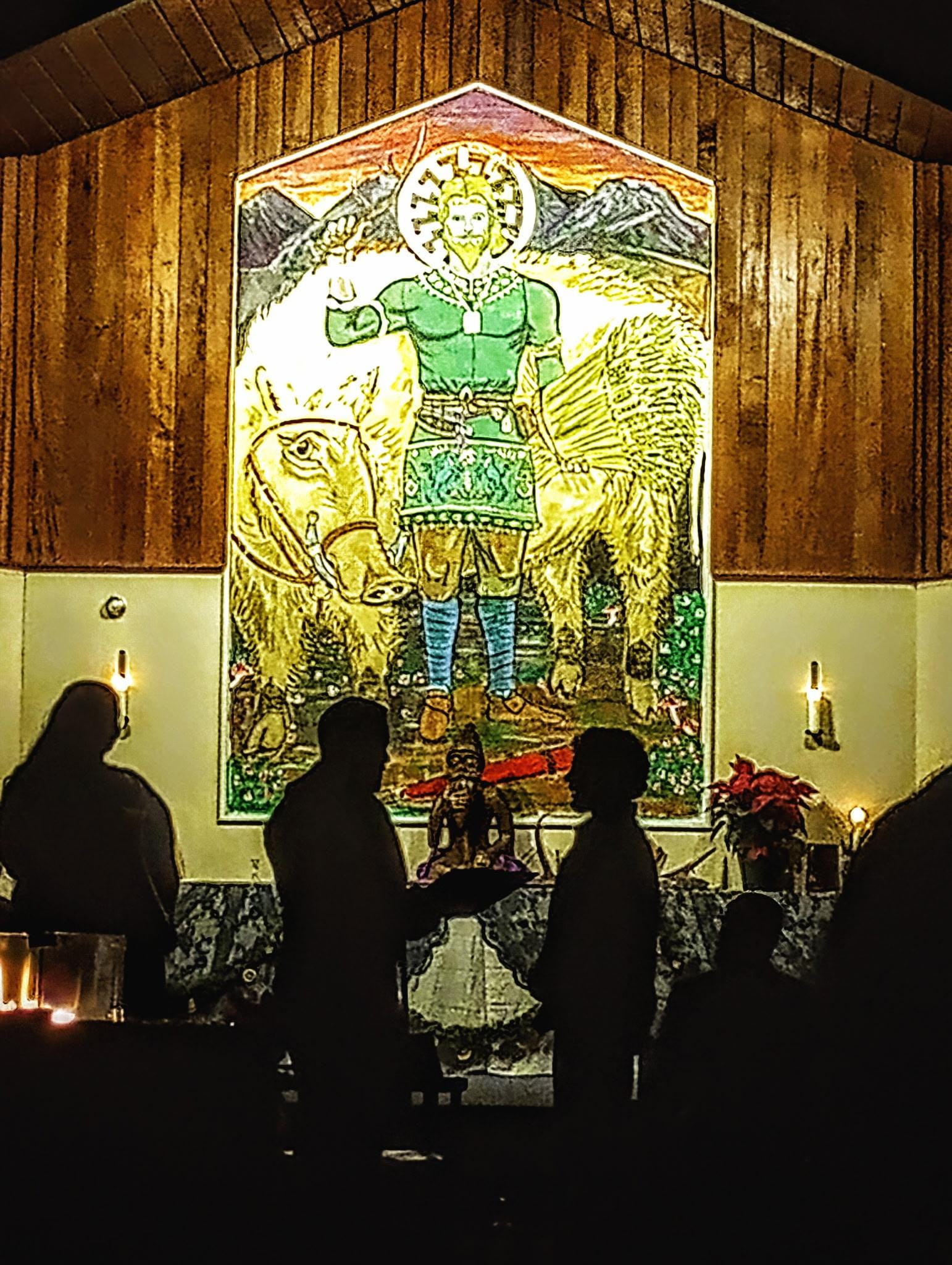
Lord Freyr is not directly associated with the berserker cult (that would be Odin) but there are some interesting things to note. First off, Lord Freyr loses his sword and must fight with a stag’s antler, a situation that will eventually lead to his defeat during Ragnarok. We can all imagine the way a warrior must feel with the loss of his weapon, and we should be able to envision his unbreakable will-to-power and vital strength as he seeks a suitable replacement so that he may re-enter the fray of battle. Freyr is more commonly associated with fertility, prosperity, good harvest, and in some regards, to kingship and ancestry; yet he is also the Lord of Alfheim, home of the light elves, who are most likely ascended ancestral spirits. These ancestral spirits are often described as being powerful beings of light who inspire fear, dread, passion, and fury into mortal men. Their counterparts, the dark elves, likely denote the dual-nature of Lord Freyr as both the bringer of abundance and the governor of burials, shown through his association with burial mounds and liminal spaces. This is further shown in the Anglo-Saxon Rune Poem where it says this about the Ing rune (which is tied to Freyr’s title, Ingui):
Ing wæs ærest mid East-Denum
gesewen secgun, oþ he siððan est
ofer wæg gewat; wæn æfter ran;
ðus heardingas ðone hæle nemdun.Ing was first seen by men among the East-Danes,
until he soon afterwards departed over the waves,
a wagon ran after him.
Thus bold men named this hero.
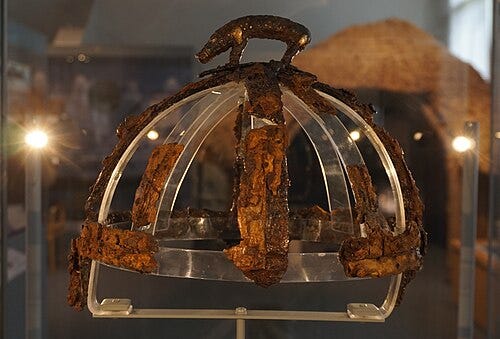
Also tied to Freyr would be the boar-motif. In Norse mythology the wild boar was an animal sacred to the Vanir — Freyr owned the boar Gullinbursti (who he rode as a barrow-boar to Baldr’s funeral) and Freyja owned Hildisvíni (battle swine). The sources speak of the Svinfylking, the boar warriors who fought at the lead of a battle formation known as the the boar’s head, a wedge formation where two champions formed the rani (snout). However, these boar-warriors are tied to Odin directly, and they probably played a more defensive role in the protection of kings and nobles. There are clear parallels here between the Germans and Celts, for the Celts also had boar-warriors, as the boar was seen as a carrier of divine frenzy, fertility, and had Otherworld associations connected to the dead. Obviously, the carnyx, the war-trumpet of the Gauls, was topped with a boar — they also had really cool boar-crested helmets. The tradition of youths hunting wild boars as an initiation, and the practice of kings hunting boars in their free-time likely stem from a cult related to these wild beasts. There’s a multitude of artifacts from the ancient world concerning boars, from the tusked helmets of the Trojans, to the boar-crested helmets of the barbarians — and in each case, we find that the wild boar exists within a liminal space, capable of birthing many piglets, and battling with wild ferocity in the defense of its woods and swamps.
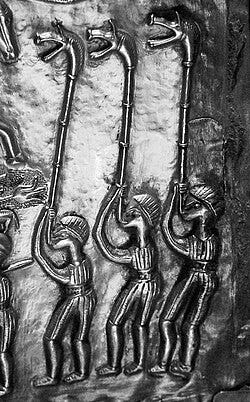
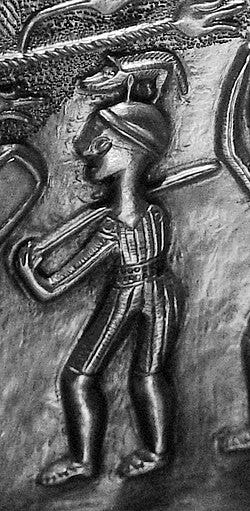
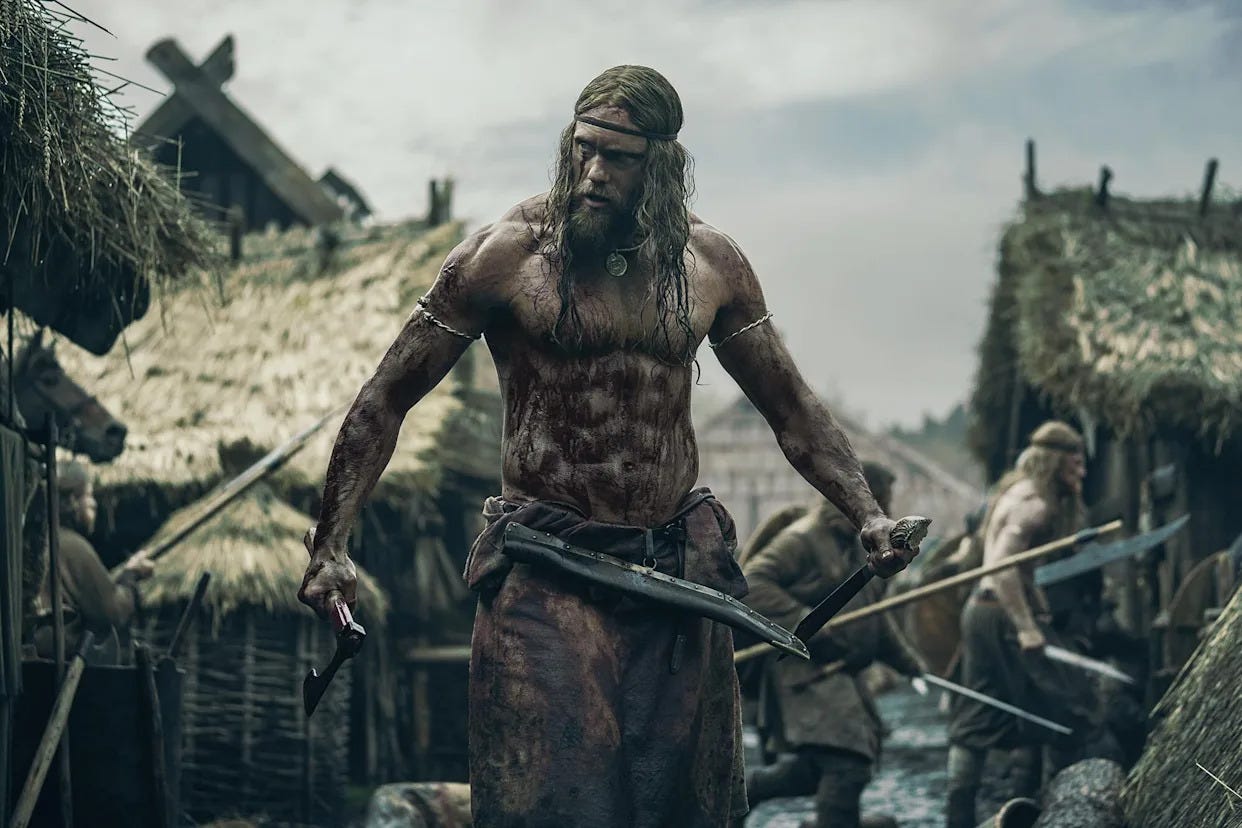
Still, these boar-warriors are not exactly the same as the berserkers, even if they experienced the same battle-fury. The Northman does a pretty good job depicting the berserker cult of the Norse, so I suggest people check out Survive the Jive’s breakdown of the film here. In this cult, young men are gathered to train in the arts of warfare, far away from the communal life of the tribe and village — out in the wilderness, where they take on the visage and likeness of predatory animals. The three main ecstatic warrior types — berserkers (bear-shirts), úlfhéðnar (wolf-heads), and svinfylking (boar-warriors) — are sometimes grouped together in popular treatments, but they have different divine associations. The úlfhéðnar (wolf-head) are described as Odin's warriors specifically, and the berserker's (bear-shirt) battle frenzy (berserksgangr) is typically an Odinic phenomenon tied to shamanic self-abandonment so as to achieve divine frenzy. The German chronicler Adam of Bremen explicitly defined this connection with the Latin phrase:
Wodan id est furor.
Wodan, that is, fury.
Our ancient ancestors in the primordial Stone Age likely developed a bear-cult, and the shamanic roots of our Indo-European ancestors clearly inherited this, along with the shape-shifting into animals which is tied to shamanism. This cult is well-attested to, both in archaeology and ethnography, for it does not exist with the Germanics and Norse alone. The Celts also had this tradition, for it stems from the Proto-Indo-European *koryos (war-party), what the Germans would’ve called the Mannerbund. This term is tied to the reconstructed word heryos (kinsmen), which is the root of the word “aryan”, clearly relating the koryos and the heryos to nobility and kinship. Tacitus describes some of these young warriors through his mentioning of the Harii, who he calls a tribe, but who may have just been gangs of these berserking youths employed in warfare by other tribes. An interesting note is that the word “Harii” may be related to this word-complex of the aryan, heryos, and koryos. It is also interesting that they are described as being painted, for the same is true for the frenzied, naked warriors of the Celts. From Germania:
…they pander to their innate savagery by skill and timing. With black shields and painted bodies, they choose dark nights to fight, and by means of the terror and shadow of a ghostly army they cause panic... In every battle the eyes are the first to be conquered.
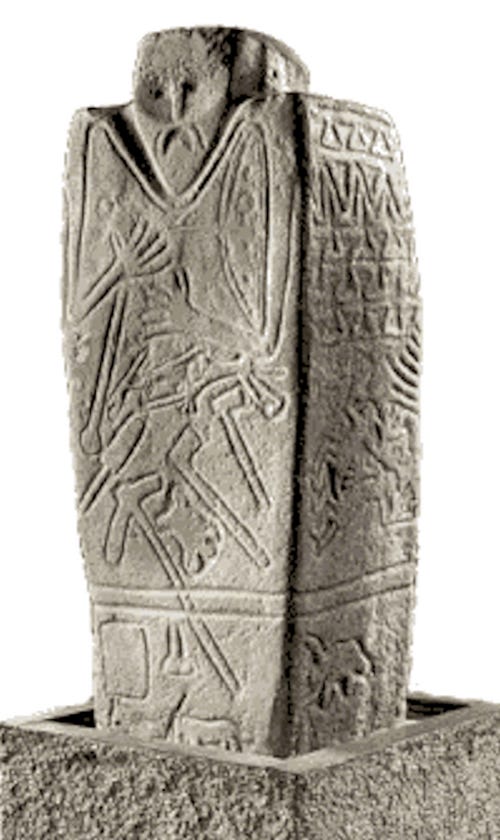
Celts have many similar practices and motifs. The boar is obvious to anyone who studies the Celts, but there are also bear, wolf, hound, and raven motifs. The names of Gaulic war leaders are often related to animals, usually something like dog-head, wolf-head, or boar-head. Celtic helmets are often depicted with birds or boars on them, and Pictish stone art depicts many stylized versions of these animals. Of course, the naked warriors of the Celts immediately brings this cult to mind, for it is theorized that the entire strategy of the Celts was to make their entire army frenzy as opposed to just a specific subset. The nudity of the young warrior is not just a Celtic idea — it is tied to the very ancient Proto-Indo-Europeans and all of their descendants, and is often depicted on stone art or mentioned in the historical annals. In warfare, men usually experience a retracting of their penis and testicles as a natural response to stress, but some men experience an erection, and this immediately draws attention to fertility and battle-frenzy. Perhaps the Freyr’s penis mogging makes more sense now?
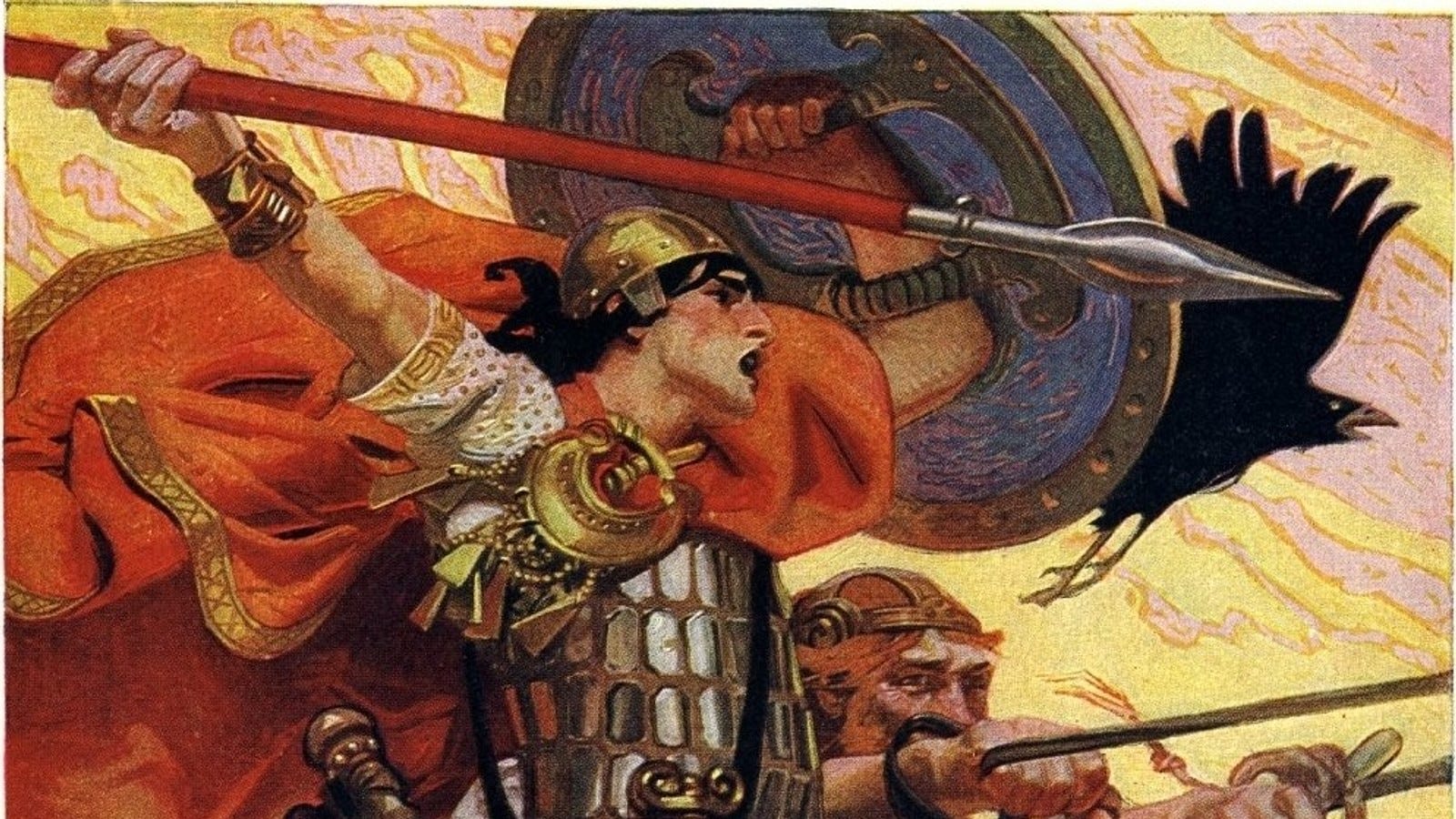
For the Gaels, the Fianna is the clearest representation of this cult. Young men, usually the sons of nobles, would band together into mercenary parties to train, hunt, feast, and commit raids and battles, only to return back to their clans at predetermined times in the year. The word Fianna might come from Proto-Celtic *wēnā (a troop), from Proto-Indo-European *weyh (to chase, pursue), which might be connected to a poetic ethnonym of the Gaels, which is Fenian. Another theory derives it from Proto-Celtic *wēd-nā (wild ones). Renowned Celticist, Heinrich Zimmer, connects the Fianna to the Norse-Gaels, deriving the name Fianna from an Irish rendering of Old Norse fiandr (brave enemies or brave warriors). The greatest hero of the Fianna is Finn McCool who is likened directly to the demi-god wolf-warrior Cú Chulainn, who has in his very name the word hound. Cú Chulainn is said to experience a riastradh, or warp-spasm, a contorting of his very being into a frenzied state which grips him during battle. Arguably, the riastradh is a form of divine possession, wherein the Gods and Goddesses of death, fertility, and warfare are summoned to fill the soul-cauldrons with their divine energy, contorting and twisting the rational side of mankind to achieve a more animalistic, and therefore liminal, state of being.
Obviously, the National Socialists embody this possession to some degree, a revolutionary political group who seem to shape much modern thought concerning the right-wing. However, we also have the honored Wandervogels who likewise influenced the National Socialists but who extend to an even older inspiration (honorable call-out to Gildhelm who keeps this memory alive). We can also find a wide array of “poets of the heath” such as Hermann Löns who wrote the amazing book The Warwolf: A Peasant Chronicle of the Thirty Years War, which is a fictional account of a Christianized pagan family who, throughout history, have always been at the forefront of their village’s history and who partake in warfare for the sake of warfare and the protection of the folk. Clearly, warfare is something that is ingrained into our bones and psyches in a way that will never be totally destroyed by the comforts of modern civilization. The irrational, naked, battle-frenzy of the North may reside in a dormant state deep in our bones, but it seeks to rear its boar-head and don the furs and skins of bears and wolves once more in an orgy of life and death with ravens and crows gnawing at the bones of the dead.
Hexenkartothek (Roxy) is one of the handful of iFunny expats who found my meager Substack and helped increase its following and fame. He has always been an interesting character with fascinating takes on the history of our movement, and although I may sometimes disagree with him on the particulars of politics or social views, this is a young man who I hold great respect towards and would like to see him honored by our folk. He is embodying an archetype of the Aryan man which is, sadly, rarely seen in this modern age. Some people would decry him for “wasting his efforts” or “serving the enemy”, but I do not partake in this childish behavior. Instead, I will honor him with a short stanza:
Youthful warrior,
Death-eyes,
Crave slaughter,
Seek battle forever,
Know no ceasing,
Relent never.
May Roxy find physical healing. This article was inspired by his recent experiences, which can be found here:

Hail the warriors of our race! Hail the glorious dead! Hail Roxy!

Hail!
Well done, Honoring your Kinfolk in this way is both virtuous and correct.
Hail Roxy! My your mighty ancestors rise at your back as you battle through life.
Hail Aodhan!